Safety cabinets, as critical equipment for ensuring the safety of personnel, samples, and the environment in laboratories, industrial sites, and medical settings, operate based on the synergistic effect of multiple protective mechanisms, achieving risk isolation and material protection through airflow control, filtration systems, and structural design. This article systematically explains the core operating principles of safety cabinets from the perspectives of airflow organization, filtration technology, pressure management, and classified applications.
1. Airflow Organization: The Basics of Directional Flow and Directional Emission
One of the core functions of a safety cabinet is to precisely control the direction of airflow to prevent the spillage and cross-contamination of hazardous substances. Taking a common biosafety cabinet (BSC) as an example, internal airflow is divided into two types: downflow and inflow. Downflow, driven by a fan, flows evenly downward from the top high-efficiency particulate air (HEPA/ULPA) filter, forming a clean air curtain covering the operating area and directly protecting samples from external contamination. Inflow, directed through the operating window opening, "draws" personnel and potentially hazardous aerosols within the cabinet into the negative pressure chamber at the rear, where it is ultimately filtered and discharged. The flow rates and balance of these two types of airflow require strict calibration. For example, Class II biological safety cabinets require a downflow velocity of 0.3-0.5 m/s and an intake air velocity of at least 0.5 m/s to ensure effective protection.
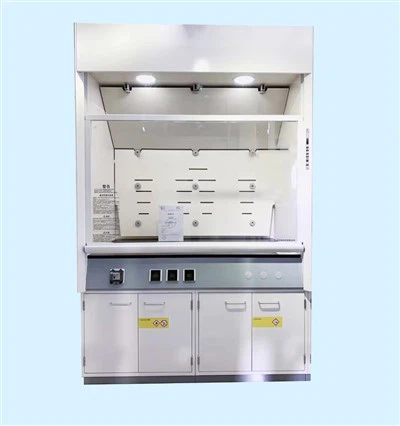
For chemical safety cabinets or explosion-proof cabinets, airflow design focuses more on internal circulation and maintaining negative pressure. These cabinets typically do not rely on external exhaust. Instead, they utilize a bottom-intake, top-return circulation pattern, coupled with fans to continuously agitate the air within the cabinet, reducing the local concentration of volatile chemicals. Furthermore, the slight negative pressure (typically 5-10 Pa below ambient pressure) created when the cabinet door is opened prevents the escape of harmful vapors and prevents inhalation by operators.
2. Filtration System: The Core Barrier for Contaminant Interception
The protection level of a safety cabinet is directly dependent on the performance of its filtration components. High-grade biosafety cabinets (such as Class II A2/B2 biosafety cabinets) generally use HEPA (High-Efficiency Particulate Air) or ULPA (Ultra-High-Efficiency Particulate Air) filters. These filters have a retention efficiency of ≥99.97% (HEPA) or ≥99.999% (ULPA) for particles 0.3μm, effectively intercepting bioaerosols such as bacteria, viruses, and fungal spores, as well as some fine dust particles. For applications involving radioactive materials or high-risk chemicals, some cabinets are equipped with a dual filtration system-a first-stage filter removes large particles, while a second-stage HEPA/ULPA filter ensures exhaust gases meet safety standards.
Filter placement within the exhaust path is crucial. Externally exhausted cabinets (such as Class II B2) require all air inside the cabinet to be HEPA-filtered and then exhausted outdoors through dedicated ducting to prevent contamination of the laboratory environment. Internally recirculating cabinets (such as Class II A2) filter only a portion of the air (approximately 70%) before recirculating it to the operating area, with the remaining 30% filtered and exhausted externally, achieving a balance between energy conservation and protection.
3. Pressure Management and Structural Sealing: The Physical Basis of Risk Isolation
Safety cabinets achieve risk isolation through a negative pressure environment and a sealed design. The cabinet interior maintains a slight negative pressure relative to the external environment (typically -5 to -15 Pa). This ensures that even if the cabinet door is not fully closed or there is a minor leak, external air is preferentially drawn into the cabinet, rather than escaping hazardous substances. For example, chemical safety cabinets typically feature magnetic sealing strips on the door edges, combined with a double-layer steel sandwich structure (filled with flame-retardant insulation material) to further reduce the risk of leaks. The operating window of a biological safety cabinet uses a motorized or mechanical mechanism to precisely control the opening height (generally no more than 200 mm), ensuring both operating space and a stable airflow balance. Furthermore, key components (such as fans and filters) are housed in independent, sealed chambers to prevent contact with residual contaminants during maintenance. Some high-end safety cabinets are also equipped with leak detection sensors that monitor the pressure differential across the filter or the amount of bacterial contamination on the cabinet surface in real time. When the detection value exceeds a threshold, an automatic alarm prompts replacement.
4. Classification, Application, and Differentiation Principles
Depending on the target of protection, safety cabinets can be divided into four categories: biological safety cabinets, chemical safety cabinets, clean benches, and explosion-proof safety cabinets. Each has its own specific operating principle:
•Biological safety cabinets: Focusing on protecting personnel, samples, and the environment, they achieve a "three-level protection" (personnel → sample → environment) through airflow management and HEPA filtration. Class III fully enclosed biological safety cabinets even require that all operations be conducted through glove ports. The cabinet is completely isolated from the outside world and exhaust is achieved through dual HEPA filtration.
•Chemical safety cabinets: Focusing on controlling volatile chemical vapors, they rely on negative pressure circulation and fire-resistant materials (such as galvanized steel with anti-corrosion coatings) to reduce the risk of explosion and poisoning. Some models are equipped with explosion-proof fans and grounding devices to prevent static ignition.
•Clean benches (ultra-clean benches): Despite their name, they are essentially unidirectional cleanroom equipment, blowing clean air downward only through a top HEPA filter (no inhaled airflow). They protect samples from ambient dust contamination but do not provide personnel or environmental protection.
•Explosion-proof safety cabinets: Designed for storing flammable and explosive liquids, they utilize antistatic coatings, ventilation holes (with flame arresters), and a limited volume structure (single cabinet storage capacity ≤ 150L), combined with ventilation and dilution to reduce the probability of explosion.
Conclusion
The operating principle of a safety cabinet is a comprehensive application of fluid mechanics, materials science, and filtration technology. Its core goal is to create a multi-layered protection system through controlled airflow, efficient filtration, and reliable isolation. With advances in materials and intelligent monitoring technologies, modern safety cabinets are evolving towards lower energy consumption (e.g., variable-frequency fans), more precise control (e.g., real-time pressure differential display), and greater automation (e.g., automatic disinfection). However, their fundamental protection strategy remains centered around "directional airflow + risk interception + physical isolation," providing essential safety assurance for high-risk operations.